 Jambolaya
Manipulation Rummy
How to play
Rearrange the melds on the table to be the first to empty your hand. Two to five can play. Most rulebooks use two 52-card packs shuffled together with no jokers (104 cards); Carousel, Vatikan and Tahiti add jokers, as described below.
The inviting player picks the Rules, each played as pagat.com describes it: Manipulation (the default), Machiavelli, Shanghai, Guadalupe, Carousel, Vatikan or Tahiti.
Some rulebooks have one more option: Must meld for Manipulation and Shanghai, Play to (200 or 300 points) for Manipulation, and Unfinished move for Machiavelli, Guadalupe and Tahiti.
Every group on the table must be a SET (3–4 cards of one rank, each a different suit) or a RUN (3 or more cards of one suit in sequence).
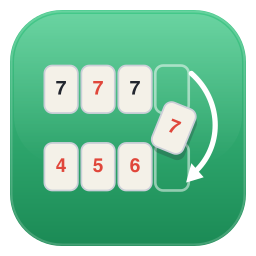
On your turn you may rebuild the table any way you like, splitting groups, moving cards between them and starting new ones, as long as you add at least one card from your hand and every group ends up valid.
You can never take a card from the table into your hand, and there is no discard pile. You rebuild on a private copy that nobody else sees: tap Done to play it, or Reset to put everything back as it was.
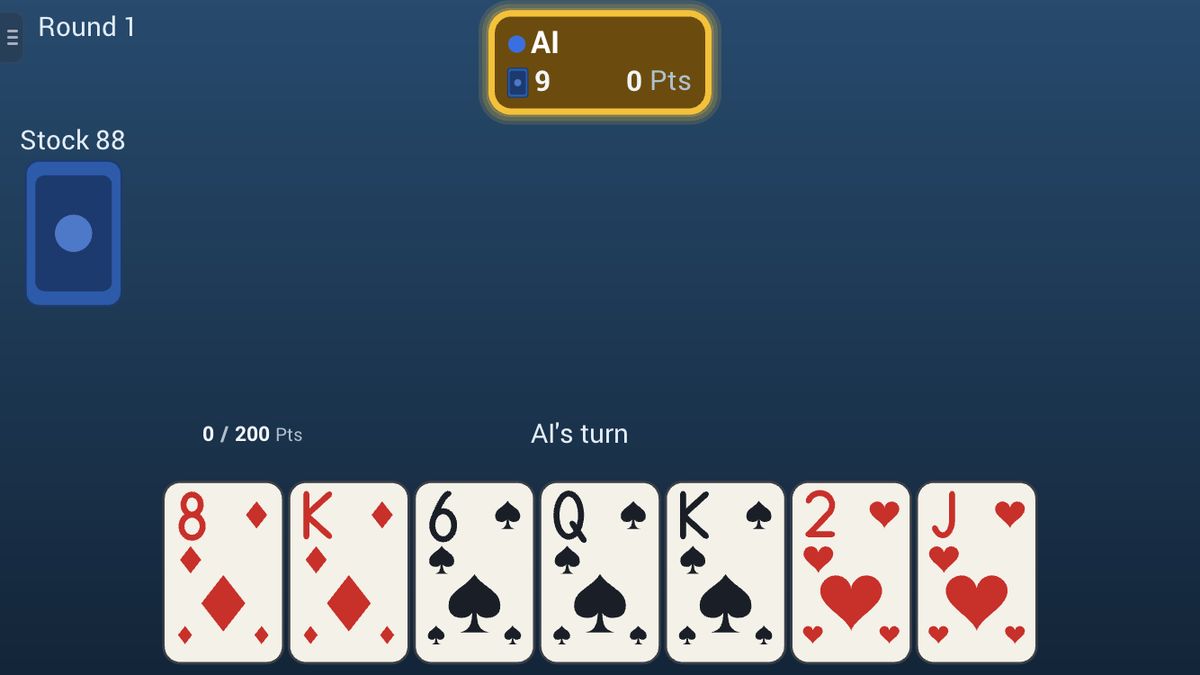
When the stock is empty you pass instead of drawing; if every player passes in a row with no meld in between, the hand is blocked and ends (Carousel ends its own way, described below). MANIPULATION deals seven cards each.
An ace counts high only: Q-K-A is a run, but K-A-2 and A-2-3 are not. You must meld (play cards) if you can; if you cannot, draw from the stock one card at a time until you can, then meld. Must meld decides how that is checked.
Remind, with a hint: if you tap Draw (or Pass) while you have a play, the table shows you one card you could play and the groups it would change, and says whether the play needs the table rearranged; tap Draw (or Pass) again to go ahead anyway.
Any valid play is accepted, not only the one shown. Trust the player: Draw and Pass work at the first tap, with no reminder. Either way your turn ends only when you meld, or pass on an empty stock.
The hand ends the moment a player puts down their last card, and every other player scores penalty points for the cards still in their hand: an ace 15, tens and face cards 10, every other card 5. A blocked hand is scored the same way.
The player who went out scores 0, so a lower total is better. Hands go on, the scores adding up, until someone reaches or passes the target; the lowest total then wins, and if the lowest total is shared, another hand is played.
MACHIAVELLI deals thirteen cards each. An ace plays high or low but never both: A-2-3 and Q-K-A are runs, K-A-2 is not. On your turn you either play cards or draw one card, and drawing ends your turn.
Unfinished move decides what a move you start but cannot finish costs. Reset, no penalty (the default): tap Reset and nothing is lost.
Take back, draw 3: once you have changed the table, Reset becomes Give up (+3); tap it twice to put everything back and draw three cards as a penalty, which ends your turn.
Machiavelli is a single hand: whoever empties their hand wins, each card left counts 1 point, a blocked hand is won by the player with the fewest cards left, and a tie for fewest is a draw.
SHANGHAI deals ten cards each, in batches of three, three, three and one. An ace is low only: A-2-3 is a run, but Q-K-A and K-A-2 are not. As in Manipulation you must meld if you can, drawing one card at a time until you can, and Must meld works the same way.
When a player puts down their last card, every other player scores 1 point for each card left in their hand, and a blocked hand is scored the same way.
Shanghai has no set ending: hands go on, the scores adding up, for as long as the players keep playing, and the lowest total leads. GUADALUPE deals five cards each. An ace plays high or low but never both, as in Machiavelli.
On your turn you either play cards or draw two cards; if you play cards without going out, you draw one card at the end of your turn. Unfinished move works as in Machiavelli.
Guadalupe is a single hand, scored like Machiavelli: whoever empties their hand wins, and each card left counts 1 point.
CAROUSEL is played by two players with one 52-card pack and one joker (53 cards), or by three to five with two packs and two jokers (106 cards). Ten cards are dealt to each player.
An ace plays high or low but never in the middle of a run: A-2-3 and Q-K-A are runs, K-A-2 is not. A joker stands for any card you choose.
When you put a joker on the table you must say which card it is, rank and suit: if more than one card fits, the table asks you when you finish your move, and if only one fits it is chosen for you. A joker on the table keeps that card.
It may move to another group, but only as the same card.
It can stand for a new card only once the real card it stands for is on the table, put there from your hand or moved from another group; the freed joker must then go straight into a group as a newly named card, and can never go back to a hand.
On your turn you always draw a card first. Then you either meld or draw a second card; after a second card you either meld or draw a third, and the third card ends your turn without a meld.
Cards left in a hand count: a joker 25, a picture card 10, an ace 1, every other card its face value. If a meld after one or two draws leaves you 5 points or fewer, the Draw button becomes Knock: knocking plays your meld and ends the hand at once.
The player with the fewest points then wins the hand and scores the difference between their points and each other player's, added together.
If someone other than the knocker has the fewest points, that player wins and scores 10 more for the undercut; if the knocker ties with another player, the other player wins with the undercut, and two players other than the knocker who tie both win.
A player who empties their hand wins the hand and scores all the points left in the other hands plus 25.
If the player who draws the last card of the stock does not knock, every player in turn, ending with that player, has one more turn to meld or pass without drawing, and nobody can knock in these last turns; then the fewest points win, and players who tie both win.
The game ends when a player's score reaches 150. That player scores 100 more, every player scores 25 more for each hand they won, and the highest total wins; a tie is a draw.
VATIKAN is played with two 52-card packs and two jokers (106 cards), and thirteen cards are dealt to each player. On your turn you either draw one card or meld, never both.
Runs, sets and jokers work as in Carousel, with one difference: a joker on the table cannot move to another group until the real card it stands for is on the table.
It stays put while you add cards to its group or split the group, as long as a card that was beside it stays with it.
The first time you meld, you must put down a run of three cards of one suit from your hand, and a joker is not one of the three; after that, in the same turn and later, you may add cards and rearrange the table freely.
Vatikan is a single hand with no scoring: whoever empties their hand wins. A blocked hand is won by the player with the fewest cards left, and a tie for fewest is a draw. TAHITI is played with two 52-card packs and four jokers (108 cards).
Five cards are dealt to each player, and four more are dealt face up to the table as single cards. You may use these single cards in your melds, but you do not have to; until one is used it stays on the table on its own, and it can never go into a hand.
On your turn you either play cards or draw one card, and an ace plays high or low but never both, as in Machiavelli; Unfinished move works as in Machiavelli too. A joker stands for any card you choose, as in Carousel, but a group can hold only one joker.
A group with a joker in it cannot be rearranged: none of its cards can move, and only cards from your hand can be added to it. To free the joker, put down the real card it stands for from your hand, never a card that is already on the table.
That group can then be rearranged too, and the joker must go into a group on the table as a newly named card.
Tahiti is a single hand: whoever empties their hand wins, and every other player scores penalty points for the cards left in their hand: a joker 30, an ace 11, a picture card 10, every other card its face value.
A blocked hand is won by the player with the fewest points left, and a tie for fewest is a draw.
Ways to play
- Against the computerPlay on one device against a computer opponent.
- Play together, nearbyWith family and friends in the same room: up to 5 players, each on their own phone or tablet. No Wi-Fi or internet needed. In the Jambolaya app.
- Learn by playingA guided lesson on the real game teaches you the rules one step at a time.
 Palace1–4 players
 Slapjack1–4 players
 Spit1–2 players
 Spite & Malice1–2 players
 Gin Rummy1–2 players
 Crazy Eights1–6 players
 Go Fish1–4 players
 Hearts1–4 players