 Jambolaya
Shape Swap
How to play
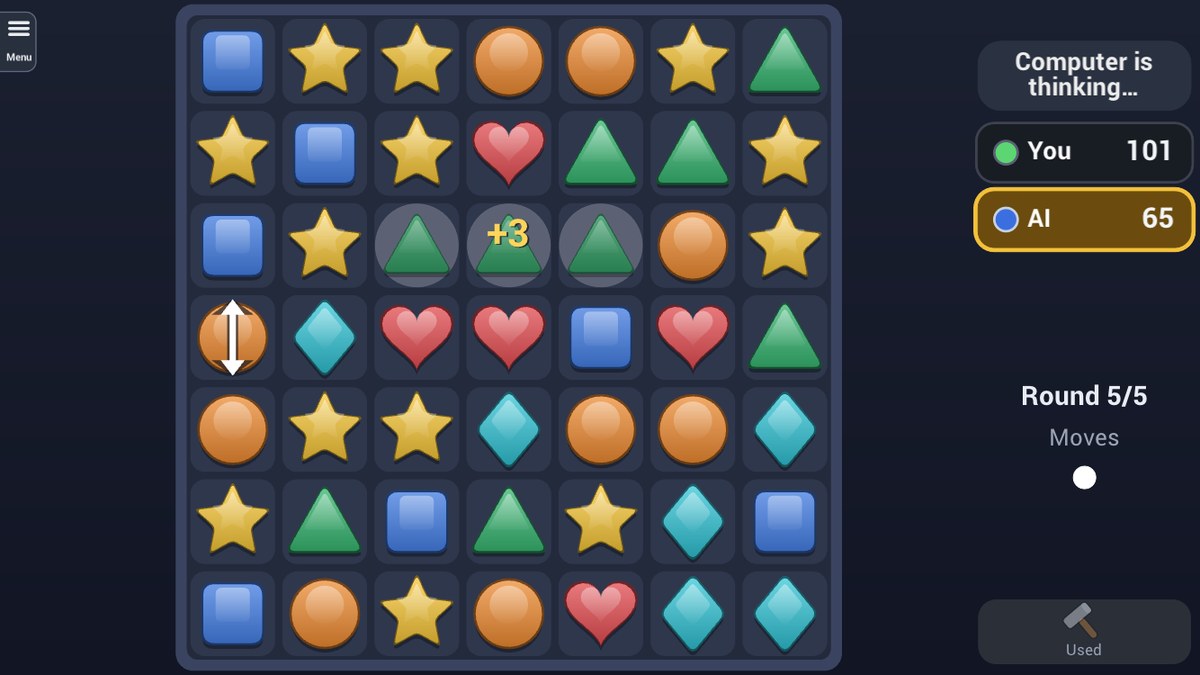
Two players share one 7×7 board of shapes and take turns. A turn is 2 moves, but the player who starts has only 1 move on the very first turn.
A move swaps two pieces side by side, up, down, left or right, and it must make a line of 3 or more of the same shape, or a 2×2 square of one shape; a swap that makes neither slides back and costs nothing.
A 2×2 square clears its 4 pieces like a line, but it leaves no special piece and gives no extra move. Every piece cleared scores 1 point for you. The pieces above fall down and new ones slide in from the top, and any new lines they make score for you too.
A line of 4 or more gives you one more move, at most one per move. A line of 4 also leaves a Line piece behind: when it is matched, it clears its whole row or column, the way its arrows point.
An L or T shape of 5 leaves a Burst piece, which clears the 3×3 squares around it when it is matched. A line of 5 leaves a Rainbow piece: swap it with any piece to clear every piece of that shape.
Each player has one Hammer per game: tap it, then tap any piece to remove it for 1 point, without using a move. If no swap is left, the board reshuffles by itself. After 5 rounds the higher score wins, and equal scores are a draw.
The level sets the number of shapes: 5 on Easy, 6 on Normal and 7 on Hard; fewer shapes mean more chains.
The aim
Shape Swap is a match-3 game for two players on one shared board. The 7×7 board is full of bright shapes: circles, squares, triangles, diamonds, stars and hearts, each shape in its own colour. You take turns swapping pieces to make lines of the same shape. Every piece you clear is a point. After 5 rounds, the player with more points wins.
How to play
A move swaps two pieces that sit side by side: up, down, left or right, never diagonally. Drag one piece onto the other, or tap one and then the other. The swap must make a line of 3 or more of the same shape. A swap that makes no line slides back and costs nothing. A 2×2 square of the same shape counts too: its 4 pieces clear and score, but it leaves no special piece and gives no extra move.
The line clears and every cleared piece scores 1 point for you. The pieces above fall down and new ones slide in from the top. If the falling pieces make new lines, those clear too, and they score for you as well.
A turn is 2 moves. The dots under Moves show how many you have left. The player who starts gets only 1 move on the very first turn, so starting first is not an unfair edge.
A line of 4 or more gives you one more move, at most one per move. A gold dot joins the others to show it.
Bigger lines leave a special piece behind, in a square of the line:
- Line piece (a line of 4): it has arrows. When it is in a line, it clears its whole row or column, the way its arrows point.
- Burst piece (an L or T shape of 5): it has a white ring. When it is in a line, it clears the 3×3 squares around it.
- Rainbow piece (a line of 5): it has every colour. Swap it with any piece to clear every piece of that shape.
Each player also has one Hammer per game. Tap the Hammer button, then any piece: that piece is removed for 1 point, and it does not use a move. The pieces above fall, so the Hammer can start a chain.
If no swap is left on the board, the board reshuffles by itself.
Scoring and the end of the game
Every cleared piece is 1 point, chains included, and the points always go to the player who moved. A round is one turn for each player. After 5 rounds the higher score wins, and equal scores are a draw.
The level sets how many shapes are on the board: 5 on Easy, 6 on Normal and 7 on Hard, where a moon joins the others. Fewer shapes mean more chains, so Easy is lively and full of surprises, and Hard asks for more planning.
Tips to play better
- Look for 4s first. A line of 4 scores, makes a Line piece and gives you another move.
- Think about what you leave behind. The board is shared. A special piece you make but cannot use yourself is a gift to the other player.
- Use your extra move on your own special. Make a Line piece with a line of 4, then match it straight away with the move you just earned.
- Match low on the board. A line near the bottom makes more pieces fall, and falling pieces often make chains.
- Spend the Hammer. It costs no move and is wasted if you finish the game with it. Use it to finish a line, set up a chain, or break up a line the other player could make.
- Swap a Rainbow with the shape there is most of. The more pieces of that shape, the bigger the score.
Common mistakes
- Taking the first line you see. Look over the whole board; a swap elsewhere may score twice as much.
- Leaving an easy 4 for the other player. Before you swap, check what the board will offer next.
- Forgetting the Hammer until it is too late. After the last round it is worth nothing.
Playing with family
Shape Swap needs no reading. Every shape has its own colour, so players who mix up colours can still tell the pieces apart. Children love the chains on Easy, and the lit neighbours show which swaps are possible, so nobody gets stuck.
The guided lesson lets you make a line of 3, a Line piece and a Burst piece, fire both, watch a whole turn of 2 moves and the computer's turn, use the Hammer, and win the game with the last move.
In Jambolaya you can play against the computer at Easy, Normal or Hard. In the app, two players can also play together nearby, each on their own phone or tablet, with no Wi-Fi or internet needed. The browser edition plays on one device.
Ways to play
- Against the computerPlay on one device against a computer opponent.
- Play together, nearbyOne-on-one with someone in the same room, each on your own phone or tablet. No Wi-Fi or internet needed. In the Jambolaya app.
- Learn by playingA guided lesson on the real game teaches you the rules one step at a time.
 Letter Ring1–4 players
 Join the Pairs1–4 players
 Minesweeper Duel1–2 players
 2048 Race1–2 players
 Klondike1–2 players
 FreeCell1–2 players
 Pyramid1–2 players
 Tri-Peaks1–2 players