 Jambolaya

Jungle Chess
How to play
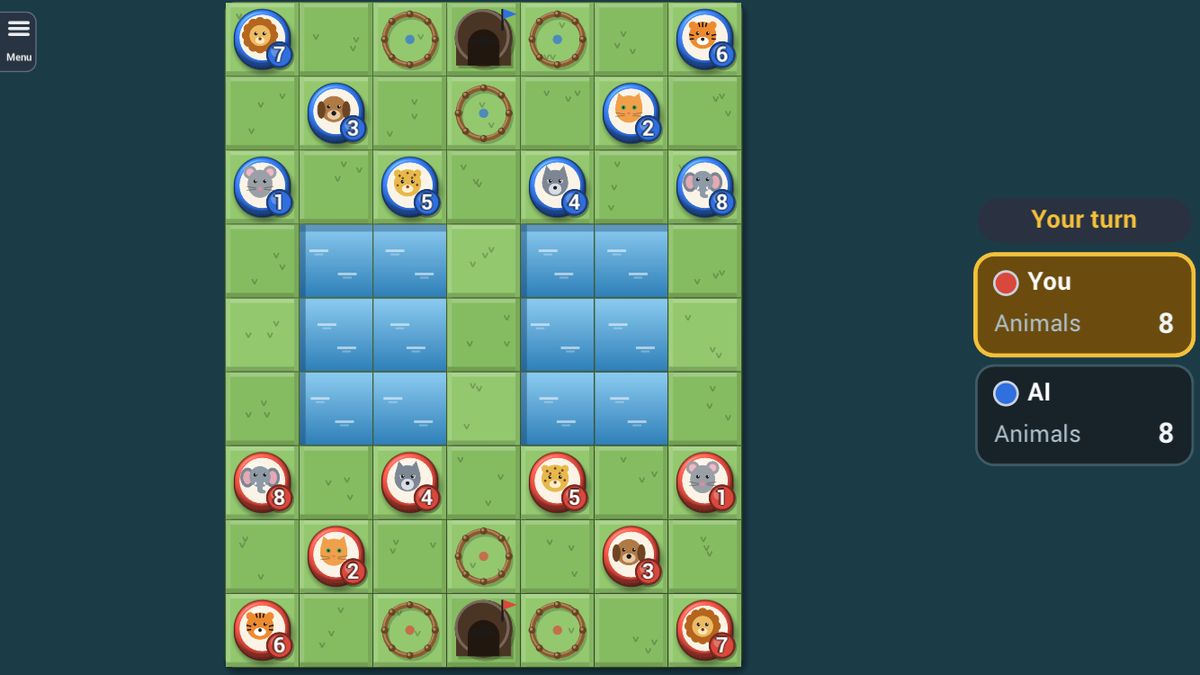
Two armies of eight animals, Red and Blue, on a board with two lakes; each side has a den and three traps around it. Ranks: elephant 8, lion 7, tiger 6, leopard 5, wolf 4, dog 3, cat 2, rat 1. On your turn move one animal one square up, down, left or right.
An animal captures an enemy of the same or a lower rank by moving onto it — but the rat captures the elephant, and the elephant never captures the rat. Only the rat swims; a rat in the water cannot capture onto land.
The lion and the tiger leap straight across a lake, unless a rat is in the water in the way. An enemy standing in one of your traps has rank 0, so any of your animals can capture it. You may not enter your own den.
Win by entering the enemy den, by capturing every enemy animal, or when the opponent cannot move. A position repeated three times, or 120 moves without a capture, is a draw.
The aim
Jungle Chess, also called Animal Chess, is played by two players on a board of 7 by 9 squares with two lakes in the middle. Each side has a den at its end of the board, with three traps around it, and eight animals. Walk any of your animals into your opponent's den to win.
How a turn works
On your turn, tap one of your animals, then one of the lit squares. An animal moves one square up, down, left or right, never diagonally.
Every animal has a rank, shown by the number on its tile:
- Elephant 8, lion 7, tiger 6, leopard 5, wolf 4, dog 3, cat 2, rat 1.
- An animal captures an enemy of the same or a lower rank by moving onto its square. A ring marks a square where you can capture.
- The rat captures the elephant, and the elephant can never capture the rat.
The lakes change everything:
- Only the rat can swim. A rat in the water cannot capture an animal on land, and an animal on land cannot capture it.
- The lion and the tiger leap straight across a lake to the first square of land beyond it, and may capture there. A rat in the water in their way blocks the leap.
The traps and the dens:
- An enemy animal standing in one of your traps has rank 0: any of your animals can capture it.
- No animal may enter its own den.
Scoring and the end of the game
You win by walking an animal into the enemy den, by capturing every enemy animal, or when your opponent has no move left. If the same position comes up three times, or 120 moves pass without a capture, the game is a draw. The cards beside the board show how many animals each side still has.
Tips to play better
- Guard your traps. An enemy in your trap is helpless, so keep an animal nearby to punish any intruder.
- Watch the rats. Your rat is the only answer to the enemy elephant, and a rat in the water can block the big cats.
- Use the leap. The lion and the tiger cross a lake in one move; a sudden leap can threaten the den from far away.
- Trade with care. Equal ranks capture each other, so the side that moves first wins the exchange.
Common mistakes
- Forgetting that the elephant cannot touch the rat.
- Leaving your den open while every animal is on the attack.
- Walking a strong animal into an enemy trap, where even a cat can take it.
Playing with family
The animals and their numbers make the rules easy to remember, and children love the rat beating the elephant. Play against the computer at three levels, or, in the app, against a friend nearby, each on your own phone or tablet, with no Wi-Fi or internet needed. The browser edition is for one device.
Ways to play
- Against the computerPlay on one device against a computer opponent.
- Play together, nearbyOne-on-one with someone in the same room, each on your own phone or tablet. No Wi-Fi or internet needed. In the Jambolaya app.
- Learn by playingA guided lesson on the real game teaches you the rules one step at a time.
 Blob Spread1–4 players
 Halma1–4 players
 Yacht1–4 players
 Cascade1–4 players
 Breakthrough1–2 players
 Lines of Action1–2 players
 Order & Chaos1–2 players
 Connect61–2 players